Networking
| Cabling technology |
10/100/1000Base-T(X) |
| Quality of Service (QoS) support |
Y |
Performance
| Duplex system |
Full |
| Ethernet LAN data rates |
10, 100, 1000 Mbit/s |
| VLAN tagging |
Y |
| Full duplex |
Y |
| Flow control support |
Y |
| Maximum transfer distance |
10000 m |
| Auto-negotiation |
Y |
| Data transfer rate |
10000 Mbit/s |
Other features
| Operating temperature (T-T) |
32 - 104 °F |
Ports & interfaces
| Fiber ports quantity |
4 |
| DC-in jack |
Y |
Power
| Power consumption (max) |
110 W |
| Input current |
1 A |
Operational conditions
| Operating altitude |
0 - 3000 m |
Additionally
| Jumbo Frames support |
Y |
| On/Off switch |
Y |
| Ethernet LAN (RJ-45) ports quantity |
48 |
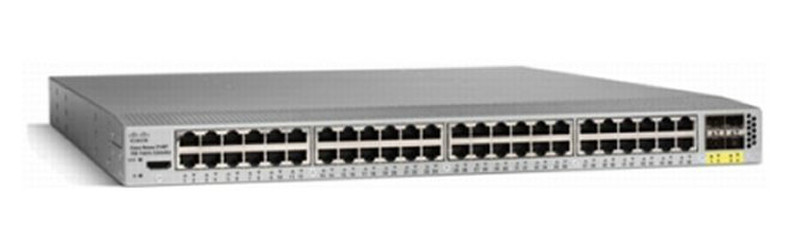
Nexus 2248TP-E Series 1GE Fabric Extender, 2PS, 1 Fan Module, 48x100/1000Base-T + 4x10GE, 32MB buffer, choice of airflow and power supply
The Cisco Nexus® 2000 Series Fabric Extenders comprise a category of data center products designed to simplify data center access architecture and operations. The Cisco Nexus 2000 Series uses the Cisco® fabric extender architecture to provide a highly scalable unified server-access platform across a range of 100 Megabit Ethernet, 1 and 10 Gigabit Ethernet, unified fabric, copper and fiber connectivity, and rack and blade server environments. The platform is well suited to support today’s traditional 1 Gigabit Ethernet environments while allowing transparent migration to 10 Gigabit Ethernet, virtual machine-aware unified fabric technologies.
The Cisco Nexus 2000 Series Fabric Extenders behave like remote line cards for a parent Cisco Nexus switch. The fabric extenders are essentially extensions of the parent Cisco Nexus switch fabric, with the fabric extenders and the parent switch together forming a distributed modular system. This architecture enables physical topologies with the flexibility and benefits of both top-of-rack (ToR) and end-of-row (EoR) deployments.
- Architecture flexibility: A common, scalable, and adaptive architecture across data center racks and points of delivery (PoDs)[1] supports various server options, connectivity options, physical topologies, and evolving needs.
- Highly scalable server access: 1 and 10 Gigabit Ethernet server access is scalable, with no reliance on Spanning Tree Protocol.
- Simplified operations: One single point of management and policy enforcement using upstream Cisco Nexus switches eases the commissioning and decommissioning of server racks through zero-touch installation and automatic configuration of fabric extenders.
- Increased business benefits: Consolidation, cabling reduction, rack-space reduction, reduced power and cooling, investment protection through feature inheritance from the parent switch, and the capability to add functions without the need for a major equipment upgrade of server-attached infrastructure all contribute to reduced operating expenses (OpEx) and capital expenditures (CapEx).