Data transmission
| MAC address table |
160000 entries |
| Supported data transfer rates |
10/100/1000 Mbps |
| Maximum data transfer rate |
320 Gbit/s |
| Number of VLANs |
4096 |
Performance
| Packet buffer memory |
512 MB |
| Noise level |
62 dB |
Networking
| Auto MDI/MDI-X |
Y |
| DHCP client |
Y |
| DHCP server |
Y |
| 10G support |
Y |
| Full duplex |
Y |
Ports & interfaces
| Basic switching RJ-45 Ethernet ports quantity |
8 |
Management features
| Quality of Service (QoS) support |
Y |
Power
| Input voltage |
200 - 240 V |
| Input current |
12 A |
Operational conditions
| Non-operating altitude |
0 - 4877 m |
| Operating altitude |
0 - 3048 m |
Power over Ethernet (PoE)
| Power over Ethernet (PoE) |
N |
Additionally
| Wireless technologies |
Wired |
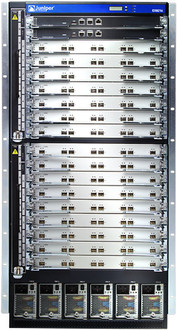
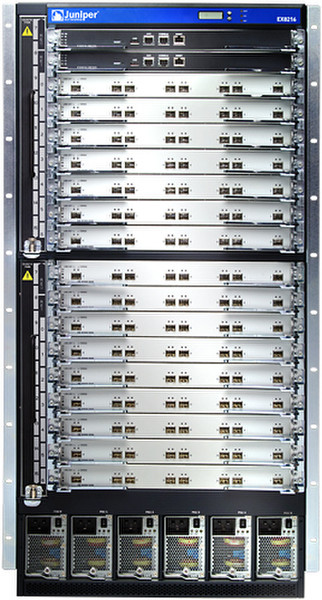
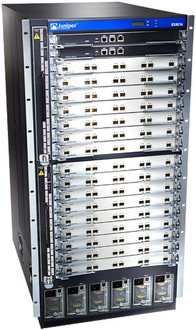
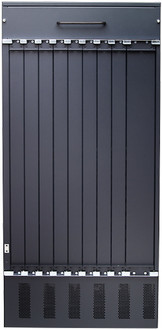
EX8208 Ethernet Switch, 550 W, 320 Gbps (full duplex)
The eight-slot Juniper Networks EX8208 Ethernet Switch, part of the Juniper Networks EX8200 line of Ethernet Switches, is ideal for aggregating access switches such as Juniper Networks EX3200 and EX4200 lines of Ethernet switches deployed in campus wiring closets and in data center top-of-rack applications. The EX8208 is also designed to support 1-Gigabit and 10-Gigabit Ethernet server access in data center end-of-row chassis deployments. In core applications, the EX8208 provides approximately 960 Mpps of high-density, wire-speed 10-Gigabit Ethernet performance for the largest campus and data center networks.
Customers can advance the economics of their network by leveraging the consistent performance of the Juniper Networks EX8200 line of Ethernet switches’ wire-speed line cards, in conjunction with the EX4500, EX4200, EX3200 and EX2200 lines of Ethernet switches and Juniper Networks Junos operating system to reduce capital and operational expenses across the network infrastructure.
EX8208 Ethernet Switch
The EX8208 switch includes an advanced set of hardware features enabled by Juniper-designed EX-PFE2 ASICs and the carrier-class Juniper Networks operating system, Junos OS, delivering the capabilities needed to support the high-performance networks of today and tomorrow.