联网
| 布线技术 |
10/100/1000Base-T(X) |
| 无线局域网连接 |
N |
内存参数
| 内存布局 |
1 x 2 GB |
| 内存类型 |
DDR3L-SDRAM |
| 内存插槽数量 |
2x SO-DIMM |
| 最大内部存储 |
16 GB |
| 内置存储器 |
2 GB |
存储介质
| 存储驱动器尺寸 |
2.5 " |
| 总存储容量 |
128 GB |
| 集成读卡器 |
N |
| 存储驱动器接口 |
Serial ATA |
| 儲存裝置 |
SSD |
环境条件
| 运行湿度范围(H-H) |
20 - 80% |
| 储存温度范围 (T-T) |
-20 - 60 °C |
| 储存相对湿度范围(H - H) |
5 - 95% |
端口 & 界面
| Line-out |
Y |
| USB2.0端口的数量 |
2 |
| 麦克风/音频输入插孔 |
Y |
| DisplayPort 数量 |
1 |
| USB 3.0(第 1代3.1)Type-A 端口数量 |
2 |
| HDMI端口数量 |
1 |
重量和尺寸
| 深度 |
252 mm |
| 重量 |
2000 g |
| 宽度 |
273 mm |
| 高度 |
37 mm |
图像
| 板载图形适配器型号 |
Intel HD Graphics 4400 |
认证标准
| 认证 |
UL, cUL ,FCC, IC, CE, VCCI, BSMI, RCM, CB |
包装数据
| 包装盒厚度 |
362 mm |
| 包装重量 |
2700 g |
| 包装盒宽度 |
390 mm |
| 包装盒高度 |
120 mm |
另外
| 主板晶片 |
Intel H81 |
| 产品色彩 |
Black |
| 以太网连接器 |
Y |
| 以太网路(RJ-45)连接接口数量 |
1 |
| 运行温度范围(T - T) |
0 - 40 °C |
Core i3-4130 3.4 GH, Intel HD4400, 2 GB DDR3L SO-DIMM, 128 GB SSD, 2x USB 2.0 Type A, 2x USB 3.0 Type A, 1GB LAN RJ-45, HDMI, DisplayPort, Windows 10
The Elo Interactive Digital Signage (IDS) touch platform featuring the Intel® Core™ 4th Generation CPUs with enhanced graphic engines enables increased customer engagement and immersive brand experiences by adding an exciting new dimension to traditional broadcast digital signage - the power of touch.
Commercial-grade.
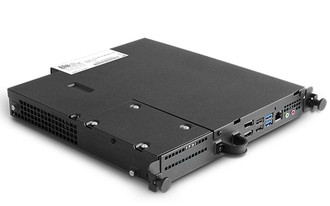
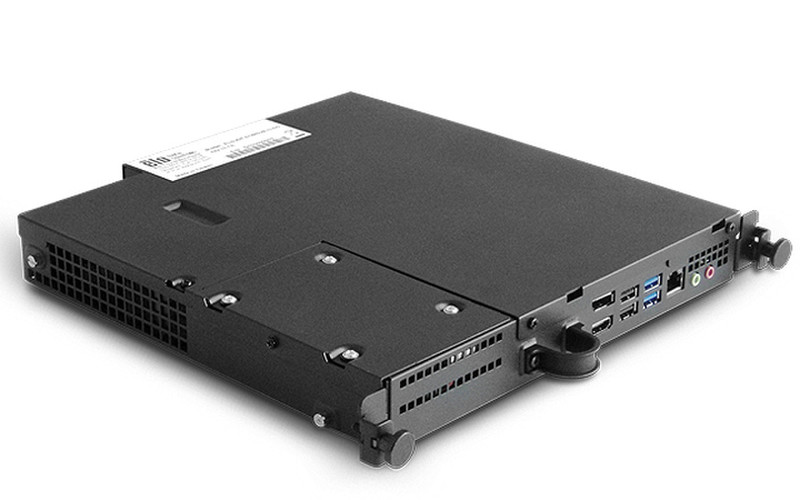
Elo's ECMG2 computer modules, available for use with the Elo 3201L, 3202L, 4201L, 4202L, 4602L, 5501LT and 7001LT IDS touchscreens are well-suited for interactive media delivery and online collaboration for modern office environments. The computer modules are easily installed into the IDS display – avoiding costs of in-wall installation of a traditional player or PC.
Powerful processing.
Computer modules are available in a choice of three models: ECMG2-i3 based on a 3.40GHz Intel® Core i3 processor and HD4400 graphics; ECMG2-i5 based on a 3.70GHz Intel® Core i5 processor and HD4600 graphics; and ECMG2-i7 based on a 4.00GHz Intel®Core i7 processor and HD4600 graphics.
Reliability.
Centralized management and security capabilities of Microsoft® Windows® ensures compatibility with many content management servers and web-based consoles for seamless connection with the internet, digital marketing, interactive whiteboard, building directory, virtual receptionist, and point-of-information (POI) applications. The ECM can also support optimal partitioning of locally cached and network stored content, allowing developers to monitor and deploy content via device-to-device or web connections.