处理器
| 处理器频率 |
500 MHz |
| 处理器光刻 |
22 nm |
| 微控制器型號 |
Intel Quark |
| 微控制器頻率 |
100 MHz |
| 64位计算 |
N |
| CPU配置(最大) |
1 |
端口 & 界面
| 通过内部接头的串行端口 |
Y |
| 串口数量 |
2 |
| 蓝牙版本 |
4.0 LE |
| 音频端口类型 |
I2S |
| 频率范围 |
2.4 - 5 GHz |
| 无线局域网连接 |
Y |
| 蓝牙 |
Y |
| USB版本 |
2.0 |
| USB 端口数量 |
1 |
产品特点
| 输出电流 |
100 mA |
| 返回到BIOS按钮 |
N |
| 延长使用期计划(XLP) |
N |
| 低卤可用选项 |
Y |
| 英特尔®可信执行技术 |
Y |
| USB On-The-Go支持 |
Y |
| 陀螺仪 |
Y |
| 物理地址扩展(PAE) |
Y |
| FSB奇偶校验 |
N |
| 可选用的嵌入式选项 |
N |
| 英特尔® 防盗技术 |
N |
| DSP传感器枢纽综合 |
Y |
| 加速度计 |
Y |
| 运动传感器 |
Y |
内存参数
| 数据宽度 |
32 bit |
| 错误更正代码 |
N |
| 内存时钟速度 |
800 MHz |
| 内存通道支持 |
Dual |
| 闪存类型 |
NAND |
| 内存类型 |
LPDDR3 |
| 闪存 |
4096 MB |
| 兼容性内存条 |
SD, SDHC |
| 最大内部存储 |
1 GB |
重量和尺寸
| 包装尺寸 |
25 x 35.5 mm |
| 棋盘尺寸 |
25 x 35.5 mm |
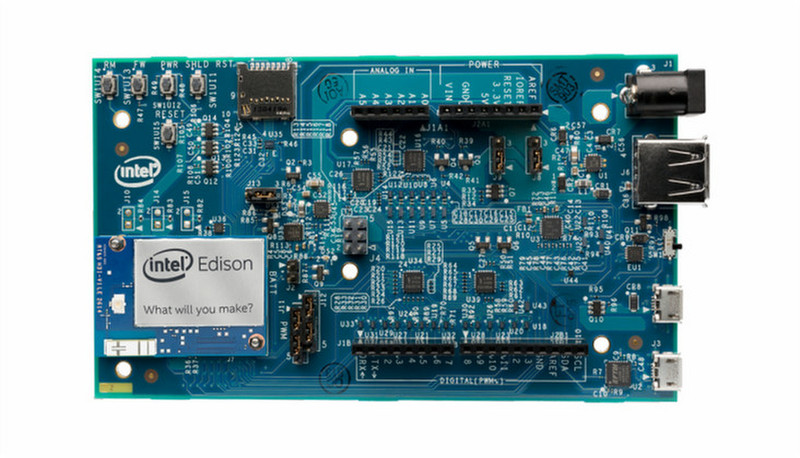
Edison Board for Arduino
The Intel® Edison compute module and breakout board kit enables users to interface with a wide range of Arduino* Uno R3 shields, allowing for quick and easy prototyping with open source hardware and a software development environment.
Make it to Market
The Intel® Edison development platform is the first in a series of low-cost, product-ready, general purpose compute platforms that help lower the barriers to entry for entrepreneurs of all sizes—from pro makers to consumer electronics and companies working in the Internet of Things (IoT). The Intel Edison development platform packs a robust set of features into its small size, delivering great performance, durability, and a broad spectrum of I/O and software support. Those versatile features help meet the needs of a wide range of customers.
- Uses a 22nm Intel® SoC that includes a dual core, dual threaded Intel® Atom™ CPU at 500MHz and a 32-bit Intel® Quark™ microcontroller at 100 MHz. It supports 40 GPIOs and includes 1GB LPDDR3, 4 GB EMMC, and dual-band WiFi and BTLE on a module slightly larger than a postage stamp.
- The Intel Edison module will initially support development with Arduino and C/C++, followed by Node.JS, Python, RTOS, and Visual Programming support in the near future.
- The Intel Edison module includes a device-to-device and device-to-cloud connectivity framework to enable cross-device communication and a cloud-based, multi-tenant, time-series analytics service.