安全
| 认证方法 |
RADIUS, PAP, CHAP, EAP |
协议
| 路由协议 |
RIP-1, RIP-2 |
| 数据链路协议 |
IEEE 802.11b, IEEE 802.11a, IEEE 802.11g |
| 管理协议 |
SNMP, HTTP, HTTPS |
| 支持网络协议 |
TCP/IP, UDP/IP, NetBEUI/NetBIOS, NTP, IP/IPX, PPPoE |
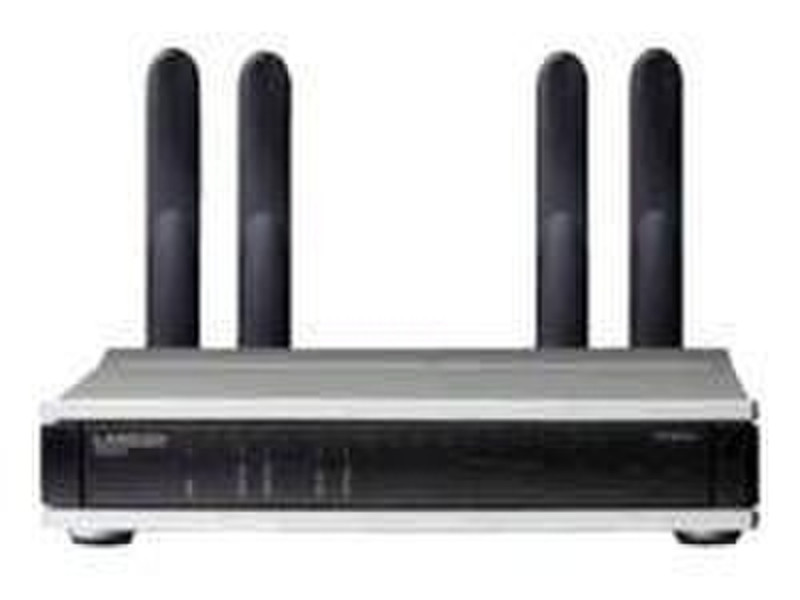
L-54 Dual- radio dual- band access point with maximum flexibility and redundancy in WAN and WLAN
- Two-times 54/108 Mbps with IEEE 802.11a/b/g/h/i
- Security from IEEE 802.11i/WPA2 802.1x, LEPS
- Optional connection of external antennas
- Redundant Power over Ethernet according to 802.3af through 2 LAN interfaces
- Integrated DSL router incl. LANCOM firewall
Twice the high-speed wireless LAN.
The LANCOM L-54 dual Wireless provides professional access point technology and maximum WLAN performance. With the two integrated 108-Mbps wireless modules that comply with the WLAN standards IEEE 802.11a/h or IEEE 802.11b/g, the LANCOM L-54 dual Wireless offers simultaneous operations in the 2.4-GHz and/or the 5-GHz frequency bands. There is no limit to the range of applications that the LANCOM L-54 dual Wireless can be used for—be it within infrastructure networks or as a WLAN bridge for network coupling.
Professional.
LANconfig, WLANmonitor and LANmonitor help to make easy work of installing and servicing the LANCOM L-54 dual Wireless, even in large-scale installations. Unique is the redundant support of the Power-over-LAN standard. The alternative of supplying electrical power via the network cable enables access points to be installed completely independently of the conventional electricity supply and its power points. And because both LAN ports support this technology, the LANCOM L-54 dual Wireless can compensate for the failure of a PoE Injector and stay operational simply by switching to the second unit.
Secure.
The LANCOM L-54 dual Wireless sets standards in security. Along with operational reliability from redundant power supplies and high availability from its two WLAN interfaces, the complete range of security standards required for professional WLAN operations are supported to the full. The range of security standards starts with WPA/802.11i, includes authentication mechanisms such as LEPS and 802.1x/EAP—and it doesn’t stop there. Still more security comes from the supplied management software, which gives the administrator a constant and reliable overview of the network status. This enables further security aspects to be handled, such as rogue AP detection.