Ports & interfaces
| Serial ports quantity |
2 |
| Host interface |
PCIe |
Other features
| Mac compatibility |
N |
| Data transfer rate |
3000 Mbit/s |
System requirements
| Minimum processor |
Intel, AMD |
Additionally
| Wireless technologies |
Wired |
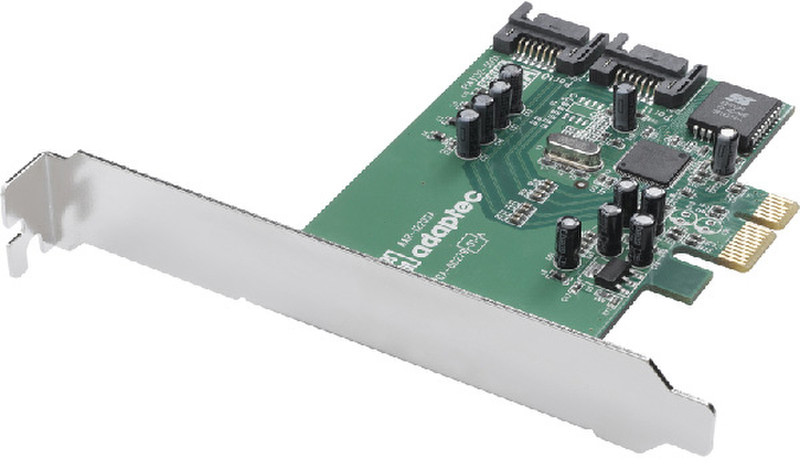
SATA II RAID 1220SA, PCI-E
PCI Express x1, 2-Port SATA 3Gb/s supporting RAID 0, 1, and JBOD
2 Serial ATA 3Gb/s ports, PCIe x1, low-profile form factor with Native Command Queuing, RAID 0, 1, and JBOD for desktops, workstations and entry-level servers.
Serial ATA, the successor technology to parallel ATA for data storage, is a point-to-point connection that delivers full throughput to
each storage device by allowing multiple ports to be managed by a single controller.
Adaptec Serial ATA technology delivers data transfer rates starting at 3.0 Gb/s and a performance roadmap that calls for extensions to 6.0 Gb/s. Adaptec Serial ATA cables are thinner, simpler to route and install, and
provide better airflow for system cooling than parallel ATA cables.
Adaptec RAID 1220SA The Adaptec RAID 1220SA card is a PCI Express x1, two-port SATA controller featuring Adaptec HostRAID™ – an integrated RAID technology that maximizes system performance and uptime. The Adaptec 1220SA supports up to two Serial ATA drives and offers RAID
levels 0 (striping), 1 (mirroring), JBOD (individual drive). The Adaptec 48-bit LBA support enables use of disk drives exceeding 137 GB in capacity. The Adaptec 1220SA supports Windows® XP,Windows 2000, Windows 2003,Netware, RedHat Linux, and SuSE Linux.
Adaptec Serial ATA RAID applications The Adaptec 1220SA allows end-users to tune their system performance and data protection. On personal computers, the striping feature of the Adaptec 1220SA bolsters the performance of applications such as audio/video streaming and gaming.
The mirroring capability of the Adaptec 1220SA protects data for applications such as personal finance. In the small office and home office environment, the Adaptec 1220SA can be used as a boot device to
protect the operating system in print, file, and storage servers.