Ports & interfaces
| Cabling technology |
10/100/1000Base-T |
| Interface type |
MDI/MDX |
| Interface |
RJ-45 |
| DC-in jack |
Y |
Performance
| VLAN support |
Y |
| Management platform |
SSID |
| Quality of Service (QoS) support |
Y |
| Modulation |
DSSS, OFDM |
Design
| Internal |
N |
| Cable lock slot |
Kensington |
Other features
| Wireless technology |
Wifi |
| Transmit power |
20dBm/100mW dBmW |
| Power LED |
N |
| Compliance industry standards |
IEEE 802.11a/b/g/n |
Antenna
| Antenna type |
3x3 MIMO |
| Antenna connector type |
2.4-2.5GHz + 5GHz |
Power
| Power over Ethernet (PoE) |
Y |
Additionally
| Transfer rate (Mbps) |
300 Mbit/s |
| Ethernet LAN (RJ-45) ports quantity |
2 |
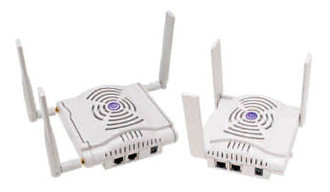
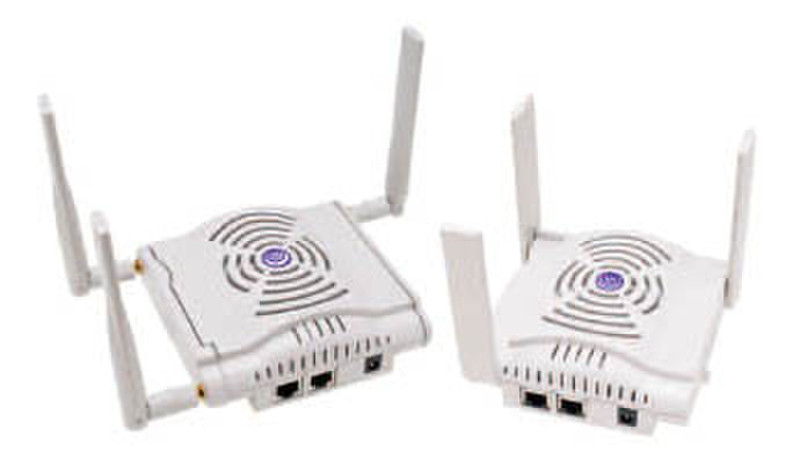
AP125, 802.11a/b/g/n, 2xRJ-45 PoE, 3x3 MIMO, 2.4-2.5GHz + 5GHz, SSID, MDI/MDX
OmniAccess AP125 wireless access point. OAW-AP125 IEEE 802.11n (draft 2.0) wireless access point with support for selectable 802.11'B/G/N' and 802.11'A/N' operation, 3x3 MIMO dual-band antenna, 2 x 10/100/1000Base-T (RJ-45) Ethernet interface (supports high power “power-over-Ethernet”), 1 x console port, 1 x 5V DC power interface. Includes installation guide and removable desktop stand. AC power adapter kit sold separately.
- High speed wireless with up to 300Mbps of throughput. Improved coverage compared to 802.11a/b/g technologies. Backward compatibility with 802.11a/b/g Wi-Fi clients;
- Operates with existing IEEE 802.3af compliant PoE devices as well as PoE+ and IEEE 802.3at devices;
- High availability with dual homing of the access point to the wireline infrastructure;
- Integral part of the OmniAccess Wireless LAN product family to offer enterprise wide high speed wireless deployments, high performance branch and small office deployments;
- Supports key enterprise grade functions such as dynamic RF management (taking into account 802.11n spectral width), air monitoring over 2.5 and 5GHz spectrum, wireless intrusion prevention, call admission control (CAC), QoS, and battery life extension for converged communication;
- When encryption keys are stored at the access points level (remote access point deployments mostly) the TPM vault protects cryptographic keys in case of AP theft or attack.