Performance
| Vertical beam width (2.4 GHz) |
15 ° |
| Antenna gain level (max) |
19 dBi |
| Horizontal beam width (2.4 GHz) |
15 ° |
| Frequency band |
2.4 GHz |
Features
| Antenna type |
Directional antenna |
| Antenna connector type |
N-type |
| Polarization |
Vertical polarization |
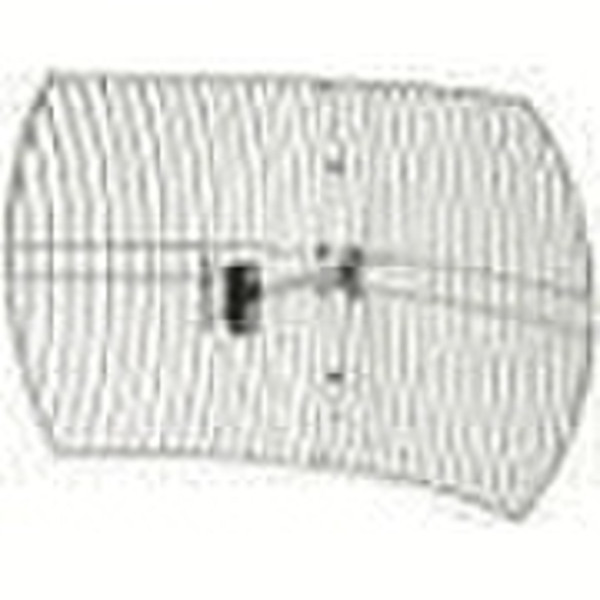
Parabolic Antenna, 2.4GHz, 19dBi, 15/15°
Parabolic
A dish-shaped, directional antenna with a radiation lobe similar to that of a panel antenna. It is usually larger than a panel and has a higher gain. Parabolic antennas are suitable for long distance point-to-point links.
Gain
Gain expresses how much an antenna enhances its transmitted and received signals relative to a simple dipole. Gain is expressed in dB and is logarithmic.
Polarization
De!nes the position in space of electrical and magnetic !elds. The best signal transfer happens when both transmitting and receiving antennas have the same polarization. A 90° difference in polarization between transmitting and receiving antennas may produce up to -30dB of signal attenuation.
Loss
Loss is the attenuation, or reduction in power, of a system, expressed in dB. All cables and connector devices have a loss variable and must be considered when designing a wireless system, especially when directional antennas are used