Ports & interfaces
| Serial port via internal header |
Y |
| Serial ports quantity |
3 |
| S/PDIF out connector |
N |
| S/PDIF in connector |
N |
| Number of digital I/O pins |
14 |
| Integrated IDE |
N |
| PWM digital I/O pins |
4 |
| Number of analog I/O pins |
6 |
| Consumer infrared Rx sensor |
N |
| Additional headers |
Arduino shield |
| USB ports quantity |
1 |
| Bluetooth |
Y |
| Wi-Fi |
N |
| USB version |
1.1 |
Features
| Back-to-BIOS button |
N |
| Extended Life Program (XLP) |
N |
| Gyroscope |
Y |
| ARK ID |
92347 |
| FSB Parity |
N |
| Embedded options available |
N |
| Input voltage (max) |
7 - 20 V |
| DSP sensor hub integrated |
Y |
| DC current per I/O pin |
20 mA |
| Accelerometer |
Y |
| Motion sensor |
Y |
| Form factor |
Arduino |
| Connector(s) |
PMIC |
| Operating voltage |
3.3 V |
| Purpose |
Robotics application |
Processor
| Processor lithography |
22 nm |
| Thermal Design Power (TDP) |
300 W |
| Microcontroller model |
Intel Quark |
| 64-bit computing |
N |
| CPU configuration (max) |
1 |
Memory
| Memory clock speed |
32 MHz |
| Memory channels |
Single |
| SRAM (Static Random Access Memory) |
24 KB |
| Internal memory type |
Flash, RAM |
| Flash memory |
0.196 MB |
| Internal storage capacity |
2 GB |
Weight & dimensions
| Package size |
8.05 x 11 x 2 mm |
| Depth |
68.6 mm |
| Width |
53.4 mm |
Additionally
| Ethernet LAN connection |
N |
Easy-to-use learning and development board enables anyone explore the foundations of programming, electronics, and mechanics with Intel performance at an entry-level price
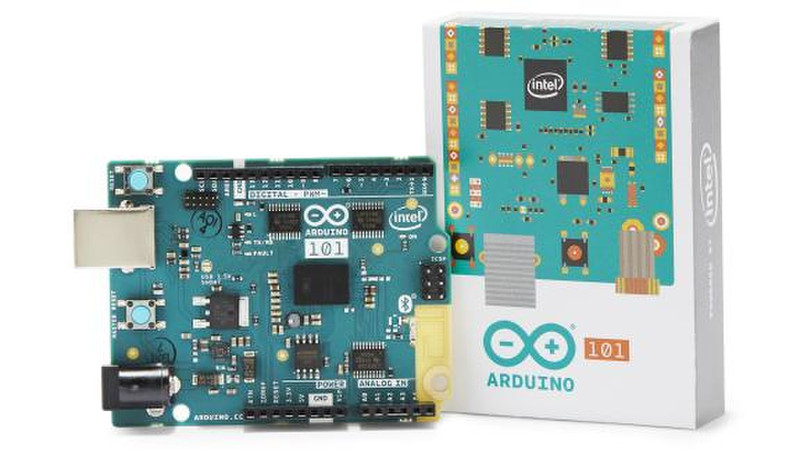
Arduino 101 Development Board
Intel and Arduino join forces to bring you a development platform as powerful as your imagination. The first widely available learning and development board based on the Intel® Curie™ Compute Module, the Arduino 101 board (branded Genuino 101 outside the U.S.), delivers Intel performance at an entry-level price.
Designed in conjunction with the founders of Arduino, this low-cost system features a 32-bit Intel® Quark™ microcontroller for minimal power consumption, 384 kB of flash memory, 80 kB of SRAM (24kB available for sketches), an integrated DSP sensor hub, Bluetooth Low Energy radio, and 6-axis combo sensor with accelerometer and gyroscope.
Boasting the advanced features of the Intel Curie module, Arduino’s open source hardware and software platforms, and a wide variety of expansion options provided by third-party shield designers, the Arduino 101 board makes it easier to learn the basics and get started as a maker.
The Arduino 101 board, powered by the Intel Curie module, is incorporated as part of the Creative Technologies in the Classroom (CTC) physical computing courseware, developed and tested by Arduino to provide elementary and secondary school educators with the tools, support, and confidence needed to introduce their students to the foundations of programming, electronics, and mechanics. The Arduino 101 board will also be the featured development board for contestants on America’s Greatest Makers, coming to television in the U.S. in 2016.