Performance
| DirectX version |
10.1 |
| HDCP |
Y |
| TV tuner integrated |
N |
| PhysX |
Y |
| OpenGL version |
3.1 |
Ports & interfaces
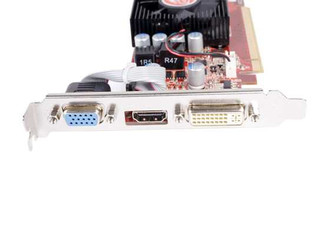
| VGA (D-Sub) ports quantity |
1 |
| Interface type |
PCI Express 2.0 |
| HDMI ports quantity |
1 |
Other features
| Mac compatibility |
N |
| HDMI |
Y |
Processor
| Processor frequency |
626 MHz |
| Shader clock |
1360 MHz |
| Stream processors |
48 |
| Maximum digital resolution |
2560 x 1600 pixels |
| CUDA |
Y |
| Graphics processor family |
NVIDIA |
| Maximum analog resolution |
2048 x 1536 pixels |
Memory
| Memory clock speed |
1580 MHz |
| Graphics adapter memory type |
GDDR3 |
| Memory bus |
128 bit |
Additionally
| Graphics controller |
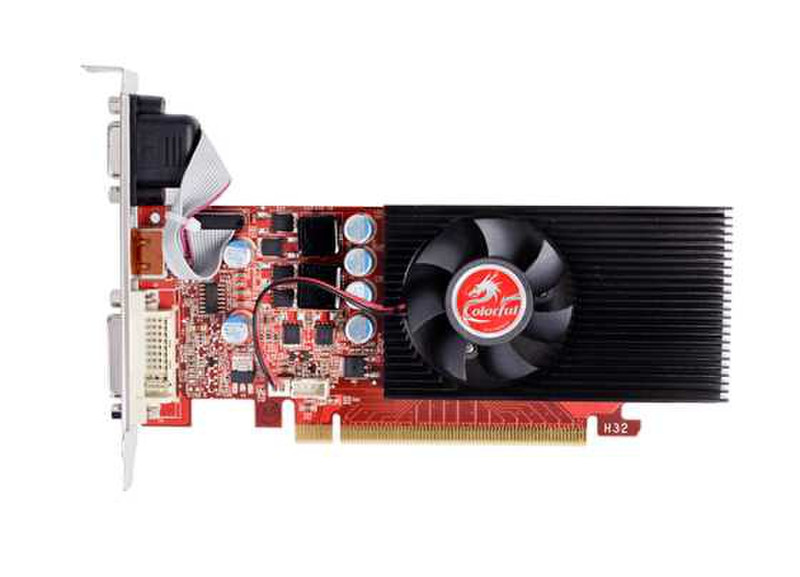
GeForce GT 220 |
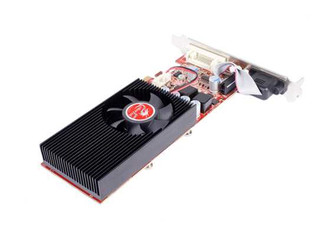
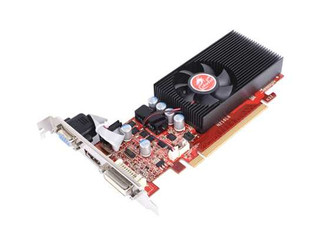
220-512M D3 LP - 512 MB, GDDR3, 128 bit, PCI Express 2.0
<b>512MB</b>
Video memory is used to hold the information necessary for a graphics card to drive a display device. In modern 3D graphics cards, the video memory may also hold 3D vector data, textures, backbuffers, overlays and GPU programs.For high end graphics cards, 1G to 2G or even more video memory is necessary to delivers all its performance power. For mid-range cards, 512M to 1G is usually enough, while for the entry level cards 256M or less is generally enough for the card performance.
<b>GDDR3</b>
GDDR3 (Graphics Double Data Rate 3) SGRAM is a graphics card-specific memory technology designed by ATI Technologies. It has much the same technological base as DDR2, but the power and heat dispersal requirements have been reduced somewhat, allowing for higher performance memory modules, and simplified cooling systems.
<b>HDMI</b>
HDMI (High-Definition Multimedia Interface) is an popular interface for audiovisual equipment such as high-definition television and home theater systems. With 19 wires wrapped in a single cable that resembles a USB wire, HDMI is able to carry a bandwidth of 5 Gbps (gigabits per second). This and several other factors make HDMI much more desirable than its predecessors, component video, S-Video and composite video.
<b>PCI-E 2.0</b>
PCI Express (Peripheral Component Interconnect Express), officially abbreviated as PCIe or PCI-E, is a computer expansion card standard designed to replace the older PCI, PCI-X, and AGP standards. PCI Express 2.0 specification was released in 2007 and doubled the rate of PCI-E 1.0 to a data rate of 500 MB/s and a transfer rate of 5.0 GT/s.