Data transmission
| MAC address table |
4000 entries |
| Store-and-forward |
Y |
| Maximum data transfer rate |
1 Gbit/s |
Other features
| Packet transfer speed |
14880pps, 148800pps, 1488000pps |
Networking
| Broadcast storm control |
Y |
| DHCP client |
Y |
| Flow control support |
Y |
Ports & interfaces
| Basic switching RJ-45 Ethernet ports quantity |
24 |
Management features
| Quality of Service (QoS) support |
Y |
Power over Ethernet (PoE)
| Power over Ethernet (PoE) |
N |
Additionally
| Wireless technologies |
Wired |
24 10/100TX + 2 10/100/1000T /Mini-GBIC Combo Web Smart Switch
- Complies with IEEE802.3/802.3u/802.3z standards
- Supports IEEE802.3x Flow Control
- Supports Port based priority and 802.1p priority tag
- Supports Port based VLAN and 802.1q Tag VLAN
- Supports Auto MDI/MDIX and N-way Auto-Negotiation
- High Switch Fabric up to 8.8Gbps
- Store-and-Forwarding switching and Non-Blocking full wire speed architecture
The EW-5226RS is a multi-port Switch that can be used to build high-performance switched workgroup networks. This switch is a store-and-forward device that offers low latency for high-speed networking. The switch is targeted at workgroup, department or backbone computing environment.
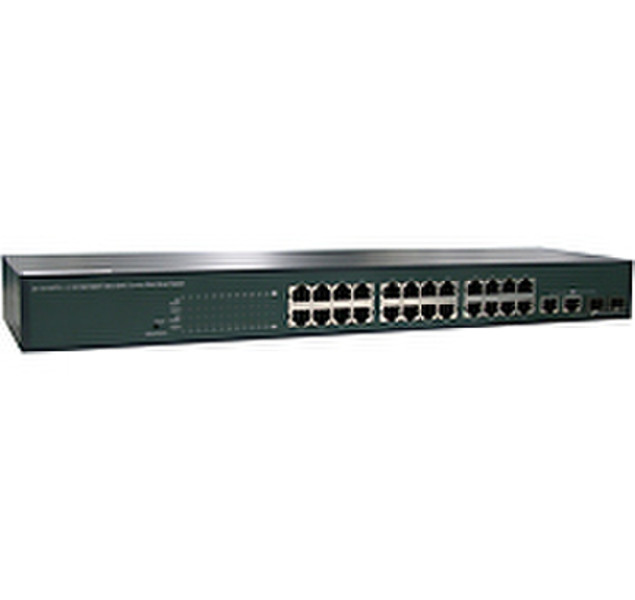
The EW-5226RS has 24 auto-sensing 10/100Base-TX RJ-45 ports and 2 auto-detect Gigabit combo ports for higher connection speed. This switch features a store-and-forward switching scheme. This allows the switch to auto-learn and store source address in a 4K-entry MAC address table.
This section provides you a few samples of network topology in which the switch is used. In general, the EW-5226RS is designed as a segment switch which with its large address table (4k MAC address) and high performance, it is ideal for interconnecting networking segments.
PC, workstations, and servers can communicate each other by directly connecting with EW-5226RS. The switch automatically learns nodes address, which are subsequently used to filter and forward all traffic based on the destination address.
By using Uplink port, the switch can connect with another switch or hub to interconnect other small-switched workgroups to form a larger switched network. Meanwhile, the user can also use fiber ports to connect switches. The distance between two switches by connecting with fiber cable can be up to 550 m (multi-mode fiber) or 10 kilometer (single-mode fiber).
ES-5226RS has configure QoS policy priority mode and CoS (Class of Service) configuration. QoS (Quality of Service) refers to mechanisms in the network software that make the actual determination of which packets have priority. CoS refers to feature sets, or groups of services, that are assigned to users based on company policy. If a feature set includes priority transmission, then CoS winds up being implemented in QoS functions within the routers and switches in the network. In an enterprise network, class of service (CoS) differentiates high-priority traffic from lower-priority traffic. Tags may be added to the packets to identify such classes, but they do not guarantee delivery as do quality of service (QoS) functions, which are implemented in the network devices.