Management features
| Multicast support |
Y |
| Quality of Service (QoS) support |
Y |
Data transmission
| Maximum data transfer rate |
1 Gbit/s |
| Switching capacity |
18 Gbit/s |
| Number of queues |
8 |
Other features
| Electromagnetic emissions |
47 CFR Parts 2 & 15, CSA C108.8, 89/336/EEC, EN, 55022, 61000-3-2, 61000-3-3 & 55024, AS/NZS CISPR 22, VCCI V-3 |
| Input frequency |
50/60 Hz |
| Networking features |
Ethernet, Fast Ethernet, Gigabit Ethernet |
Networking
| Link aggregation |
Y |
| Flow control support |
Y |
Ports & interfaces
| Basic switching RJ-45 Ethernet ports quantity |
48 |
Design
| Safety |
UL 60950, CSA C22.2 No. 60950, 73/23/EEC, EN 60950, IEC 60950, EN 60825, 2 CFR 1040.10 |
Power
| Input voltage |
90 - 264 V |
| Input current |
1.8 A |
Power over Ethernet (PoE)
| Power over Ethernet (PoE) |
N |
Additionally
| Wireless technologies |
Wired |
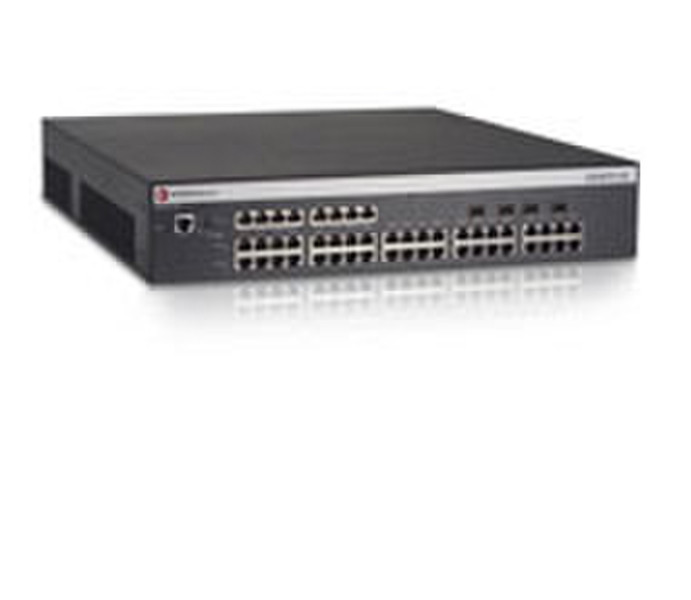
Matrix N Standalone switch with 48-port 10/100/1000Base-TX ports via RJ45 and four 1000Base-X ports via mini-GBIC
Flow-based switching and routing for granular control of users and applications
Delivering the most advanced Secure Networks® capabilities, the Enterasys Matrix® N Standalone is the fourth generation of flow-based switching from Enterasys offering 10/100/1000Mbps and Gigabit workgroup connectivity.
What’s the advantage of flow-based switching? You benefit from granular, firewall-like control of access, authentication, authorization, bandwidth, protocols, applications and users. Visibility is extended beyond the port or the VLAN to the individual conversation. Role-based policy control is extended to hundreds of downstream users or devices attached to third-party networking equipment, wireless infrastructure or VPN concentrators. It is all based on an open architecture built using industry-standards for multi-vendor interoperability to protect your investments.
The Matrix N Standalone inspects and classifies incoming traffic; makes L2/L3/L4 forwarding decisions; enforces security and QoS policies; discovers attached voice/video/data users, applications and devices; and authenticates them using 802.1x, Web and/or MAC multi-user authentication simultaneously on every interface.