Performance
| Processor frequency |
800 MHz |
| Internal memory |
1024 MB |
| Flash memory |
256 MB |
Ethernet LAN features
| Cabling technology |
10/100/1000Base-T(X) |
| Ethernet LAN data rates |
10, 100, 1000 Mbit/s |
Ports & interfaces
| WAN connection |
Ethernet (RJ-45) |
| USB ports quantity |
1 |
Mobile networking
| Data network |
Not supported |
Protocols
| DHCP client |
Y |
| DHCP server |
Y |
Design
| Form factor |
1U |
| Rack mounting |
Y |
Operational conditions
| Operating altitude |
0 - 5000 m |
Additionally
| Ethernet LAN connection |
Y |
| Ethernet LAN (RJ-45) ports quantity |
2 |
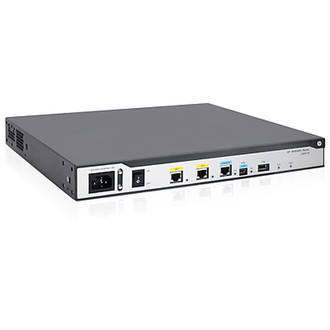
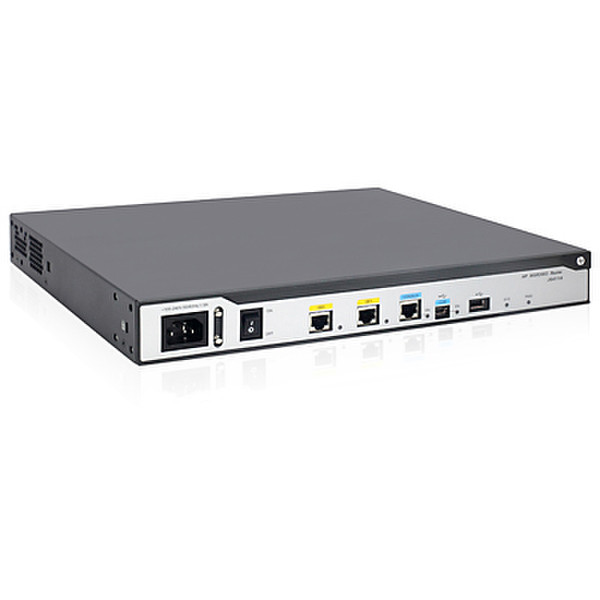
HP MSR2003 AC Router
The HP MSR2000 router series is a second generation HP Multi-Service Router (MSR G2) that supports HP FlexBranch solution as part HP's overall comprehensive HP FlexNetwork architecture. The HP MSR2000 router series features a modular design that delivers unmatched application services for small to medium sized branch offices while reducing complexity, simplifying configuration, deployment and management. The MSR2000 router series provides a full-featured, resilient routing platform, including IPv6 and MPLS, up to 1 Mpps forwarding capacity and 400 Mbps of IPsec VPN encrypted throughput. The MSR2000 router multi-core processors ensures high performance and reliable routing, switching, SIP/voice, 3G/4G WAN and security services all in one device.
Performance
• Excellent forwarding performance: provides forwarding performance up to 1 Mpps (672 Mbps); meets the bandwidth-intensive application demands of enterprise businesses
Product architecture
• Ideal multi-service platform: provides WAN router, Ethernet switch, wireless LAN, 3G/4G WAN, firewall, VPN, and SIP/voice gateway all in one device
Connectivity
• High-density port connectivity: provides up to three interface module slots and up to 15 fast Ethernet ports
Layer 2 switching
• Spanning Tree Protocol (STP): supports standard IEEE 802.1D STP, IEEE 802.1w Rapid Spanning Tree Protocol (RSTP) for faster convergence, and IEEE 802.1s Multiple Spanning Tree Protocol (MSTP)
Layer 3 routing
• Static IPv4 routing: provides simple, manually configured IPv4 routing
Layer 3 services
• Address Resolution Protocol (ARP): determines the MAC address of another IP host in the same subnet; supports static ARPs; gratuitous ARP allows detection of duplicate IP addresses; proxy ARP allows normal ARP operation between subnets or when subnets are separated by a Layer 2 network
Quality of Service (QoS)
• Nested QoS: provides a built-in QoS engine that supports nested QoS (Same to hierarchical QoS) and can implement a hierarchical scheduling mechanism based on ports, user groups, users, and user services.