Memory
| Graphics adapter memory type |
GDDR5 |
| Memory bandwidth (max) |
148 GB/s |
| Memory bus |
384 bit |
| Memory clock speed |
1550 MHz |
| Discrete graphics adapter memory |
3 GB |
System requirements
| Server operating systems supported |
Windows Server 2008 |
Other features
| HDMI |
N |
| Mac compatibility |
N |
Processor
| Graphics processor family |
NVIDIA |
| CUDA |
Y |
Ports & interfaces
| Interface type |
PCI Express x16 |
Performance
| PhysX |
N |
| TV tuner integrated |
N |
| HDCP |
N |
Design
| Number of slots |
2 |
| Cooling type |
Passive |
Additionally
| Graphics controller |
Tesla M2050 |
| Dual-link DVI |
N |
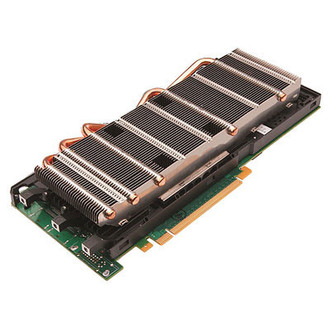
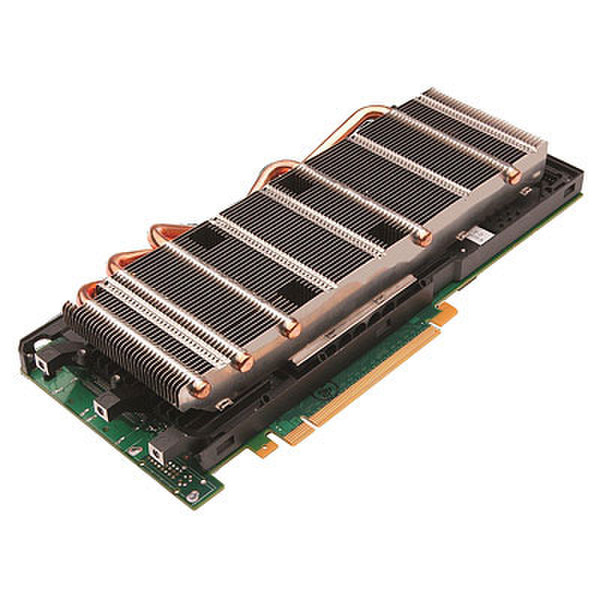
Tesla M2050, 3072 Mb DDR5, 1550 Mhz, 384-bit, PCIe x16
- The NVIDIA Tesla Computing Modules enable seamless integration of GPU computing with HP ProLiant servers for scale-out deployments. The Tesla GPUs have a capacity of up to 6 GB of GDDR5 memory with ECC, and peak performance of 655 double-precision Gflops or over 1.3 single-precision Tflop. The Tesla M2070Q combines Tesla’s high performance computation with the NVIDIA Quadro® professional-class visualization in the same GPU. The HP GPU Ecosystem includes the CUDA programming interface and third-party CUDA development tools, as well as HP-supported GPU-aware cluster software such as the HP Cluster Management Utility (CMU). CMU will monitor and display GPU health such as temperature and will also install and provision the GPU drivers and the CUDA software. In addition, HP HPC Linux Value Pack includes a GPU-enhanced version of Platform LSF, with the capability of scheduling jobs based on GPU requirements.
- May dramatically reduce computational time for parallel applications. Reduces time to solution, thus enabling businesses to solve problems previously limited by CPU speed