Networking
| Spanning tree protocol |
Y |
| Flow control support |
Y |
| DHCP client |
Y |
| Auto-sensing |
Y |
| 10G support |
N |
| Port mirroring |
Y |
| Broadcast storm control |
Y |
| VLAN support |
Y |
| IGMP snooping |
Y |
| Link aggregation |
Y |
| Full duplex |
Y |
| Routing entries |
32 |
Ports & interfaces
| Basic switching RJ-45 Ethernet ports quantity |
24 |
| Combo SFP ports quantity |
4 |
| Console port |
RJ-45 |
| Basic switching RJ-45 Ethernet ports type |
Gigabit Ethernet (10/100/1000) |
Performance
| Packet buffer memory |
2 MB |
| Internal memory |
128 MB |
| Flash memory |
16 MB |
| Stackable |
Y |
| Memory type |
SDRAM |
Data transmission
| Latency (1 Gbps) |
3.2 µs |
| Throughput |
35.7 Mpps |
| Switching capacity |
48 Gbit/s |
Management features
| Quality of Service (QoS) support |
Y |
| Multicast support |
Y |
| Web-based management |
Y |
Security
| Access Control List (ACL) |
Y |
| SSH/SSL support |
Y |
Power over Ethernet (PoE)
| Power over Ethernet (PoE) |
N |
Design
| Form factor |
1U |
| Rack mounting |
Y |
Operational conditions
| Heat dissipation |
212 BTU/h |
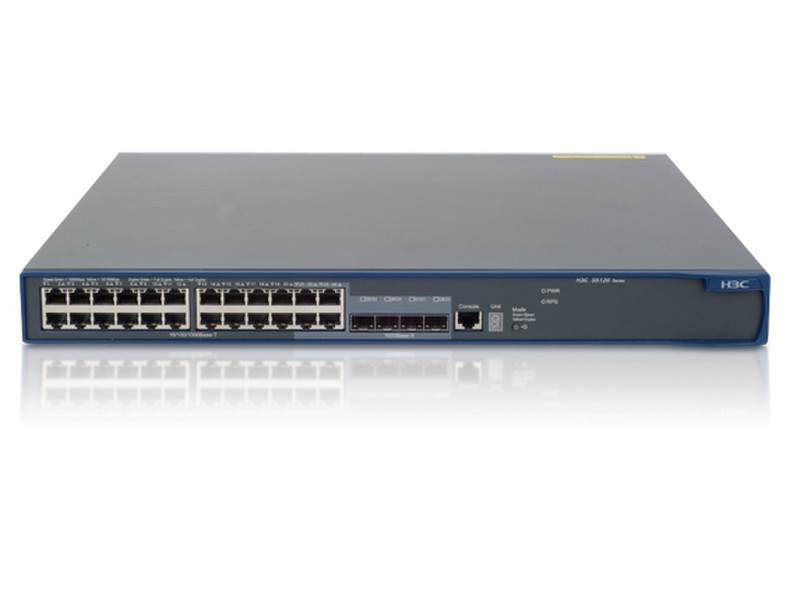
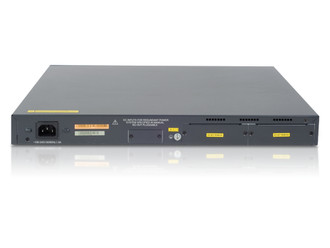
HP 5120-24G EI Switch
The HP 5120 EI Switch Series is comprised of Gigabit Ethernet switches that support static Layer 3 routing, diversified services, and IPv6 forwarding, as well as provide up to four 10-Gigabit Ethernet (10GbE) extended interfaces. Unique Intelligent Resilient Framework (IRF) technology creates a virtual fabric by managing several switches as one logical device, which increases network resilience, performance, and availability, while reducing operational complexity. These switches provide Gigabit Ethernet access and can be used at the edge of a network or to connect server clusters in data centers. High scalability provides investment protection with two expansion slots, each of which can support two-port 10GbE expansion modules. High availability, simplified management, and comprehensive security control policies are among the key features that distinguish this series.
Quality of Service (QoS)
• Broadcast control: allows limitation of broadcast traffic rate to cut down on unwanted network broadcast traffic
Management
• Friendly port names: allows assignment of descriptive names to ports
Connectivity
• Auto-MDIX: automatically adjusts for straight-through or crossover cables on all 10/100/1000 ports
Performance
• Nonblocking architecture: up to 192 Gbps nonblocking switching fabric provides wire-speed switching with up to 143 million pps throughput
Resiliency and high availability
• Separate data and control paths: separates control from services and keeps service processing isolated; increases security and performance
Layer 2 switching
• 16K MAC address table: provides access to many Layer 2 devices
Layer 3 services
• Address Resolution Protocol (ARP): determines the MAC address of another IP host in the same subnet; supports static ARPs; gratuitous ARP allows detection of duplicate IP addresses; proxy ARP allows normal ARP operation between subnets or when subnets are separated by a Layer 2 network