Security
| Authentication method |
802.1x |
| VPN support |
PPTP |
| Firewall security |
Y |
Networking
| Cabling technology |
10/100BASETX |
| Supported data transfer rates |
10, 100Mb/s |
Technical details
| Interface |
ISDN BRI |
| Wi-Fi |
N |
| Compliance industry standards |
802.3af |
Protocols
| Management protocols |
SNMP |
| Supported network protocols |
PPPoE, NAT, H.323-NAT, RSTP, NTP |
| Supported protocols |
H.323 v5\nSIPv2 (RFC 3261)\nSIP over UDP, TCP, TLS, SIPS\nRTP, SRTP, RTCP\nT.38 |
Memory
| Flash memory |
8 MB |
| Internal memory |
32 MB |
Power
| Power over Ethernet (PoE) |
Y |
| Input frequency |
50 Hz |
| Input current |
0.2 A |
| Input voltage |
100 - 240 V |
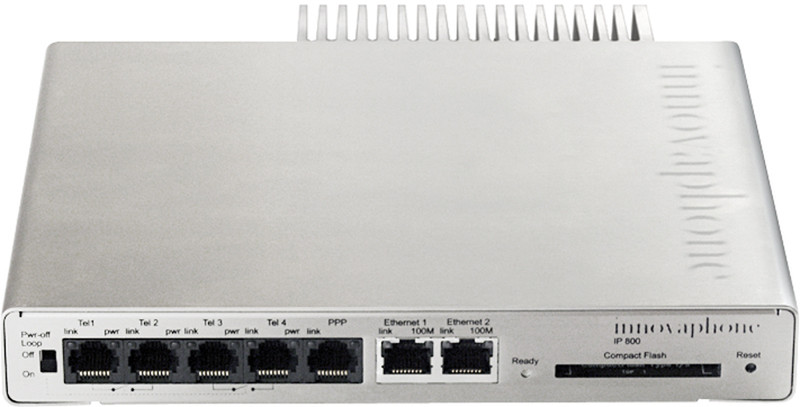
VoIP Gateway, 5 x BRI ISDN, 2 x Fast Ethernet RJ-45, CF I Card Slot, PoE
The VoIP gateway IP800 is a smaller gateway for ISDN basic rate interfaces. It is perfect for smaller PBX installations or for integrating branches as well as smaller offfices with a "local break-out".
The IP800 gateway can be used with several different configurations. All five ISDN BRI interfaces may be switched to ISDN, thus providing 10 lines simultaneously. Two of these ISDN interfaces may be configured so that they are looped through to existing trunk lines. It allows smooth migration from traditional telephony to VoIP. Hardware redundant systems are also set up in this configuration; they can replace each other immediately without interruption, thus reducing possible failure times to a minimum.
The IP800 has two separate Ethernet interfaces. They can be addressed individually and may take over routing functions between two networks. The second ethernet connection can be used as a console port. To do this, the second port is provided with a fixed IP address; a PC used for administration can be connected directly to the gateway.