Features
| Intel vPro Technology |
N |
| Form factor |
Arduino |
| Intel Matrix Storage Technology |
N |
| Back-to-BIOS button |
N |
| Extended Life Program (XLP) |
N |
| Intel Rapid Storage Technology |
N |
| Low halogen options available |
Y |
| Intel Fast Memory Access |
N |
| Intel Flex Memory Access |
N |
| Intel Trusted Execution Technology |
N |
| Intel® Small Business Advantage (Intel® SBA) |
N |
| Physical Address Extension (PAE) |
Y |
| ARK ID |
83137 |
| Intel Remote Wake technology |
N |
| Intel Remote PC Assist Technology (RPAT) |
N |
| Intel Quiet System Technology (QST) |
N |
| Intel Quick Resume Technology |
N |
| FSB Parity |
N |
| Embedded options available |
N |
| Intel AC'97 technology |
N |
| Intel Client Initiated Remote Access (CIRA) technology |
N |
| Trusted Platform Module (TPM) |
N |
| Intel® Anti-Theft Technology (Intel® AT) |
N |
| Intel® Virtualization Technology (Intel® VT) |
N |
Ports & interfaces
| Wi-Fi |
N |
| USB version |
2.0 |
| Serial port via internal header |
Y |
| Serial ports quantity |
1 |
| Ethernet interface type |
Fast Ethernet |
| Audio port type |
I2S |
| Power over Ethernet (PoE) |
Y |
| Power over Ethernet (PoE) voltage |
12 V |
| USB ports quantity |
3 |
Weight & dimensions
| Width |
72 mm |
| Package size |
15 x 15 mm |
| Depth |
123.8 mm |
Memory
| Maximum memory card size |
32 GB |
| Memory bandwidth (max) |
2.5 GB/s |
| Memory bus |
32 bit |
| ECC |
N |
| Memory clock speed |
800 MHz |
| Memory channels |
Single |
| Flash memory type |
NOR |
| SRAM (Static Random Access Memory) |
512 KB |
| EEPROM (Electrically Erasable Programmable Read-Only Memory) |
8 KB |
| Internal memory type |
DDR3 |
| Flash memory |
8 MB |
| Compatible memory cards |
MicroSD (TransFlash), MicroSDHC |
| Maximum internal memory |
0.256 GB |
Processor
| Processor frequency |
400 MHz |
| Processor lithography |
32 nm |
| Thermal Design Power (TDP) |
12.5 W |
| Processor cache |
16 KB |
| Microcontroller model |
Intel Quark |
| 64-bit computing |
N |
| CPU configuration (max) |
1 |
| Processor cores |
1 |
Software
| Linux operating systems supported |
Y |
| Mac operating systems supported |
Y |
| Windows operating systems supported |
Y |
Expansion slots
| PCI Express x1 slots |
1 |
| PCI version |
2.0 |
| PCI Express interface data lanes |
x1 |
| Mini PCI Express slots (full) |
1 |
Additionally
| Ethernet LAN connection |
Y |
| Intel AES New Instructions |
N |
| Intel HD Audio Technology |
N |
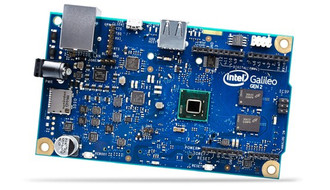
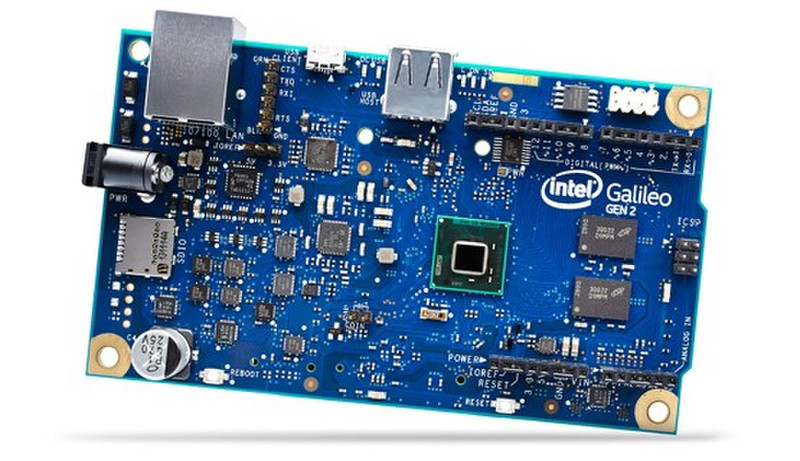
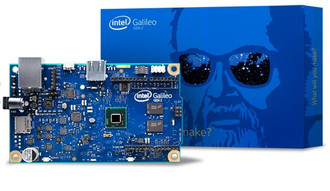
Intel Galileo Gen 2 Board
Compatible with the Arduino software development environment. In addition to Arduino hardware and software compatibility, the board has several PC industry standard I/O ports and features to expand capabilities beyond the Arduino shield ecosystem.
What will you make?
The Intel® Galileo Gen 2 board is the first in a family of Arduino-certified development and prototyping boards based on Intel® architecture and specifically designed for makers, students, educators, and DIY electronics enthusiasts. Providing users with a fully open source hardware and software development environment, the Intel Galileo Gen 2 board complements and extends the Arduino line of products to deliver more advanced compute functionality to those already familiar with Arduino prototyping tools. The Intel Galileo Gen 2 development board is designed to be hardware-, software-, and pin-compatible with a wide range of Arduino Uno R3 shields and additionally allows users to incorporate Linux firmware calls in their Arduino sketch programming.
- Intel® Quark™ SoC X1000 application processor, a 32-bit, single-core, single-thread, Intel® Pentium® processor instruction set architecture (ISA)-compatible, operating at speeds up to 400 MHz.
- Support for a wide range of industry standard I/O interfaces, including a full-sized mini-PCI Express slot, 100 Mb Ethernet port, microSD* slot, USB host port, and USB client port.
- 256 MB DDR3, 512 kb embedded SRAM, 8 MB NOR Flash, and 8 kb EEPROM standard on the board, plus support for microSD card up to 32 GB.
- Hardware and pin compatibility with a wide range of Arduino Uno R3 shields.
- Programmable through the Arduino integrated development environment (IDE) that is supported on Microsoft Windows, Mac OS, and Linux host operating systems.
- Support for Yocto 1.4 Poky Linux release.
Whats new with the Intel® Galileo Gen 2 board
- 6-pin 3.3V USB TTL UART header replaces 3.5 mm jack RS-232 console port for Linux debug. New 6-pin connector mates with standard FTDI USB serial cable (TTL-232R-3V3) and popular USB-to-Serial breakout boards. 12 GPIOs now fully native for greater speed and improved drive strength.
- 12-bit pulse-width modulation (PWM) for more precise control of servos and smoother response.
- Console UART1 can be redirected to Arduino headers in sketches, eliminating the need for soft-serial in many cases.
- 12V power-over-Ethernet (PoE) capable (PoE module installation required).
- Power regulation system changed to accept power supplies from 7V to 15V.