Networking
| DHCP server |
Y |
| Wi-Fi |
Y |
| Number of users |
100 user(s) |
| Multicast support |
Y |
| Number of VLANs |
10 |
| VPN tunnels quantity |
25 |
Other features
| Electromagnetic compatibility |
FCC B, CE B, A-Tick, VCCI B |
| Authentication method |
RADIUS, RSA SecureID, LDAP |
| Safety |
CSA, CB |
| Expansion slots |
2 x Mini-PIM |
| Power LED |
Y |
Management features
| Web-based management |
Y |
| Connectivity LEDs |
Y |
Performance
| Syslog |
Y |
| Heat dissipation |
122.8 BTU/h |
| Concurrent connections |
8000 |
Security
| Firewall security |
POP3, HTTP, SMTP, IMAP, FTP, IM |
Data transmission
| Firewall throughput |
90 Mbit/s |
Protocols
| Management protocols |
HTTP/HTTPS, SSH, Telnet, NSM, SNMP |
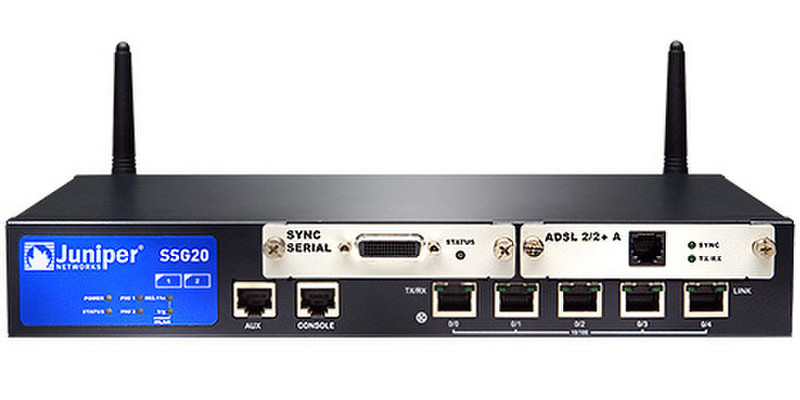
Secure Services Gateway 20 with 2 port Mini-PIM slots, Wireless 802.11a/b/g, 256 MB memory, ETSI
The Juniper Networks Secure Services Gateway 20 (SSG 20) are purpose-built security appliances that deliver a perfect blend of performance, security and LAN\WAN connectivity for small branch office and small business deployments. Traffic flowing in and out of the branch office can be protected from worms, Spyware, Trojans, and malware by a complete set of Universal Threat Management (UTM) security features including Stateful firewall, IPSec VPN, IPS, Antivirus (includes Anti-Spyware, Anti-Adware, Anti-Phishing), Anti-Spam, and Web Filtering.
The rich set of UTM security features allows the SSG 20 to be deployed as a stand alone network protection device. With its robust routing engine, the SSG 20 can also be deployed as a traditional branch office router or as a combination security and routing device to help reduce IT capital and operational expenditures - the SSG 20 is a modular platform that delivers 160 Mbps of Stateful firewall traffic and 40 Mbps of IPSec VPN throughput.
The SSG 20 are ideally suited for branch offices, small to medium businesses and service providers that want a security platform to protect their WAN and high speed internal networks while extending the platform return on investment through high levels of system and interface modularity.