Data transmission
| MAC address table |
8000 entries |
| Supported data transfer rates |
10/100/1000 Mbps |
| Switching capacity |
32 Gbit/s |
| Maximum data transfer rate |
1 Gbit/s |
Ports & interfaces
| Basic switching RJ-45 Ethernet ports quantity |
16 |
| DC-in jack |
Y |
| SFP module slots quantity |
4 |
| SFP/SFP+ slots quantity |
4 |
Performance
| Packet buffer memory |
0.5 MB |
| Stackable |
Y |
Other features
| Networking features |
Ethernet, Fast Ethernet, Gigabit Ethernet |
Operational conditions
| Operating temperature (T-T) |
32 - 104 °F |
Power over Ethernet (PoE)
| Power over Ethernet (PoE) |
N |
Additionally
| Jumbo Frames support |
Y |
| Wireless technologies |
Wired |
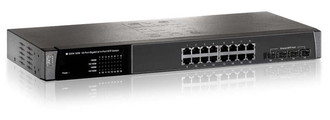
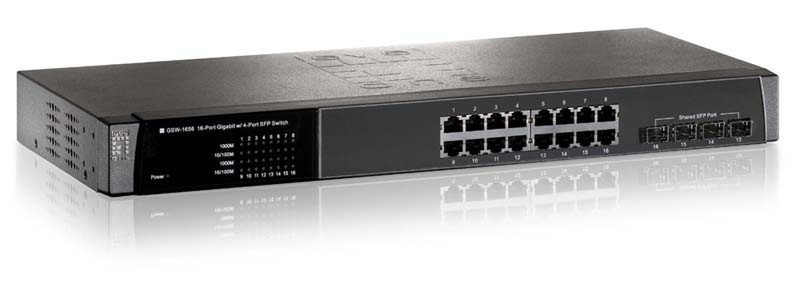
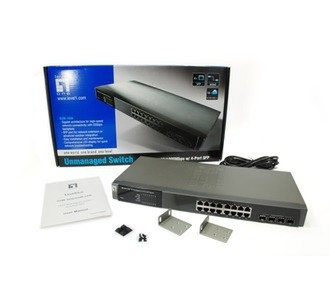
GSW-1656 Unmanaged 16 Port 10/100/1000Mbps with 4 SFP Ports
GSW-1656 is a Gigabit switch that is the ideal solution for networks that demand a reliable and stable high-bandwidth environment to connect workgroups with file servers. GSW-1656 has 16 10/100/1000 Mbps Nway ports of which 4 ports are SFP shared ports. These SFP ports are Mini-GBIC ports for obtaining long distance network connectivity via fiber optic connections. With a 32 Gbps backplane, GSW-1656 provides high-speed data transmission through effective buffering to each port. With a store-andforward switching architecture the data flow between transmit and receive nodes is controlled to protect against packet loss.
Save Power With LevelOne Green Technology
Active Link Detection: A LevelOne Green devicecan tell if there is activity on each individual
LAN port. If an 8-port switch only has 6 active devices connected to it, power is saved because no traffic is routed to the 2 inactive ports. Cable Length Detection: The switch is able to detect the distance of the connected device and adjusts its power accordingly. For example, if you have a LevelOne Green switch a computer connected to a 10-meter cable will consume less power than a computer connected to a 100-meter cable.
Sleep Mode: The device will enter sleep/standby mode when the connected devices are powered down and no active links are detected. This helps save energy consumption during extended periods of network inactivity, such as nights, weekends and holidays.