Other features
| Supported network protocols |
Modbus/TCP, TCP/IP, UDP, DHCP, Bootp, SNMP, HTTP, CGI, SNTP |
| Sensor type |
NPN, PNP, Dry contact |
| Electrostatic Discharge (ESD) protection |
15 kV |
| Input voltage range |
0 - 10 V |
| Accuracy |
±0.1% FSR @ 25°C \n±0.3% FSR @ -10 and 60°C |
| Input current range |
0 - 20 mA |
| Voltage |
24 V |
| Signal direction |
Output |
| Resolution |
16 bit |
| Serial interface type |
RS-485 |
| Channel type |
Sink |
| Power consumption |
282 mA |
| Input impedance |
200000 Ω |
Features
| Channels quantity |
12 channels |
| Isolation |
3 kV |
Additionally
| Ethernet LAN (RJ-45) ports quantity |
1 |
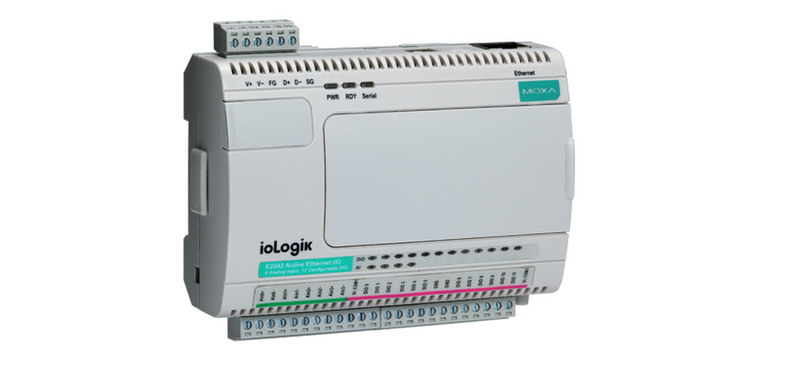
Active Ethernet micro controller with 4 analog inputs and 12 configurable DIOs, -40 to 75°C
Moxa’s ioLogik E2200 is a new type of Ethernet micro RTU controller, which is a PC-based data acquisition and control device that uses proactive, event-based reporting to control I/O devices. Unlike traditional RTUs, which are passive and must poll for data, Moxa’s ioLogik E2200 series with Active OPC Server makes seamless connection with SCADA systems a reality. In addition, SNMP is used for communicating with an NMS (Network Management System) for IT field users. The I/O status of an Ethernet micro RTU controller can be reported and controlled automatically on-site based on user specified conditions. This report-by-exception approach, which is new to PC-based monitoring, requires far less bandwidth than traditional polling methods.
<b>Active Alarm with Control Intelligence</b>
The ioLogik E2200 Micro RTU supports simple and powerful Click&Go™ technology to deliver event-driven reports and allow alarm messages to be sent by email, TCP/UDP, and SMNP Trap with real-time stamps. With built-in Click&Go™ intelligence, the ioLogik E2200 micro RTU can be used for simple output control when it is triggered by input status, without the need for a PC controller. The ioLogik E2200 micro RTU reports I/O status automatically based on user-specified conditions. This report by-exception approach requires far less bandwidth than the traditional polling approach.