Performance
| Receiver sensitivity |
-84 dBm @ 11 Mbps, -87 dBm @ 5.5 Mbps,\n-89 dBm @ 2 Mbps, -91 dBm @ 1Mbps |
Other features
| Connectivity LEDs |
Y |
| Electromagnetic emissions |
EN55022 A, EN55024, ETSI EN 301 489-17, ETSI EN 301 489-1, FCC 17 B A, FCC 15 C |
| Safety |
UL60950-1, EN60950-1 |
| Maximum operating distance |
100 m |
| Compliance industry standards |
IEEE802.11b |
Ports & interfaces
| Interface |
RS-232/422/485, RJ45 |
Protocols
| Supported network protocols |
ICMP, IP, TCP, UDP, DHCP, BOOTP, Telnet, DNS, SNMP, HTTP, SMTP |
Additionally
| Transfer rate (Mbps) |
100 Mbit/s |
| Ethernet LAN (RJ-45) ports quantity |
2 |
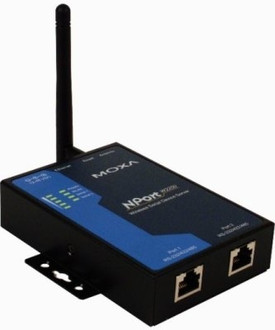
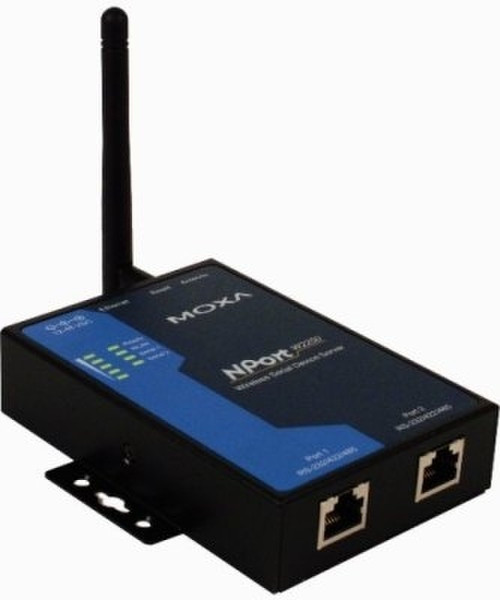
NPort W2250 2-port Wireless Serial Device Server
802.11b Wireless Connectivity to Serial Device
For hard-to-wire situations, a wireless Serial Device Server is the ideal solution to reduce the number of connection cables. When using Infrastructure Mode or Ad-Hoc Mode, NPort W2250/2150 can communicate with any host computer via an access point or another NPort W2250/2150 located up to 100 meters away in an open area.
Works with Existing Software, Saving you Time and Money
NPort W2250/2150 supports field proven Real COM/TTY drivers for Windows and Linux system, ensuring that existing PC software will still work when used with the new Wireless LAN infrastructure. TCP Server, TCP Client, and UDP modes are also supported so that IP-based software (e.g., Telnet) can use IP and TCP port number to access each device directly.
Easy-to-use Remote Management and Configuration Tools
NPort W2250/2150 comes with a Windows utility that automatically searches for and locates the Wireless Serial Device Server over an Ethernet network. An easy-to-use Wizard (via the web console) guides you through the entire installation in just
a few minutes.