Ports & interfaces
| DVI port |
N |
| USB version |
2.0/3.0 (3.1 Gen 1) |
| HDMI ports quantity |
1 |
| USB ports quantity |
2 |
Display
| Active display area (W x H) |
1549.44 x 871.56 mm |
| HD type |
Full HD |
| Display type |
LCD |
Computer system
| Computer system |
N |
| Image formats supported |
BMP, GIF, JPG, PNG |
| Internal storage capacity |
8 GB |
| Internal memory |
1 GB |
| Processor frequency |
1.5 GHz |
Other features
| Compatible memory cards |
SD |
| Card reader integrated |
Y |
Packaging data
| Handheld remote control |
Y |
| Warranty card |
Y |
| Mounting kit |
Y |
Performance
| TV tuner integrated |
N |
| Wi-Fi |
Y |
Additionally
| Ethernet LAN (RJ-45) ports quantity |
1 |
| Ethernet LAN connection |
Y |
177.8 cm (70 ") (1920 x 1080) LED, 1073.7M, Quad Core 1,5 Ghz, 8 GB ROM, 1GB RAM, Wi-Fi, HDMI, USB 2.0, USB 3.0, RJ-45, 320W, 75kg, Android 4.2
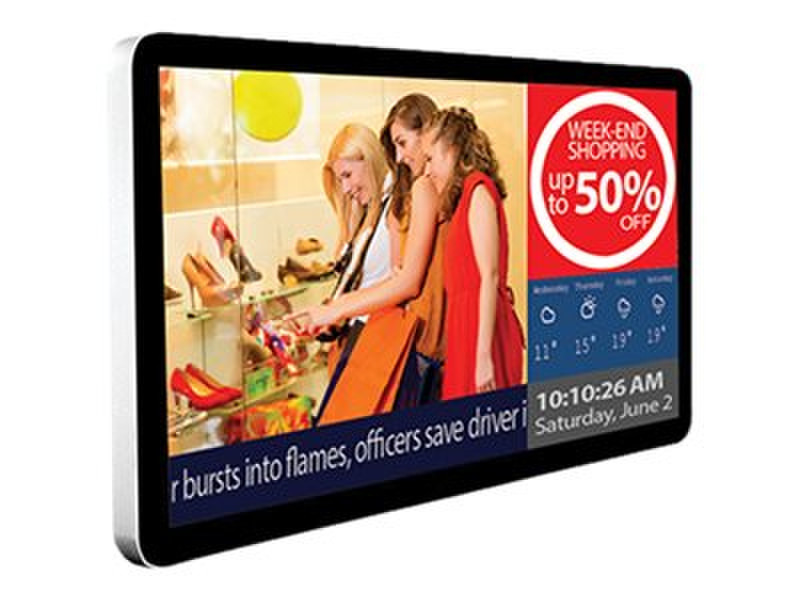
The SmartMedia LFD monitors for Digital Signage, have a simple and elegant design with rounded corners, ideal for any decor and location. Reliable, strong screens, designed and tested to operate continuously 24 hours a day, 7 days a week in addition to low power consumption. They can be equipped with touch screen capability (optional) and increased brightness to be placed high light areas.
You can choose different model sizes and features: 32 "to 84" with resolutions ranging from Full HD to 4K.
1.5 GHz Quad Core with 8 GB of internal memory that supports playback of many types of media.
The integrated USB reader supports most common file formats for images, audio, and video: RMVB, MPEG-4, DivX, XviD, H.264.
It can be used vertically and horizontally, the LFD monitors are easy to install with simple wall brackets supplied;
They are equipped with Wi-Fi, SD card reader, and a simple free software for Digital Signage Cloud control Included.
The LFD monitor or kiosk dedicated to digital signage ,is managed via an Internet connection or locally programmable.
Each LFD monitor comes with Free cloud-based software allowing remote control of the units from an internet portal. Individual device attributes can be managed remotely via WiFi or LAN or locally via USB port. The end user can control features such as screen orientation, file uploads, and campaign scheduling.
The program for communications and multimedia files can be setup in a continuous loop mode or specific scheduling can be deployed.