Performance
| Maximum transfer distance |
80000 m |
| Fiber mode structure |
Single-mode |
| Tx power (max) |
-2 dBmW |
| Wavelength |
1550 nm |
| Link budget |
26 dB |
| Sensitivity |
-34 dBmW |
| Tx power (min) |
-8 dBmW |
Ports & interfaces
| DC-in jack |
Y |
| Fiber ports quantity |
1 |
Power
| Input current |
0.5 A |
| External power adapter |
Y |
| Input voltage |
12 V |
Networking
| Ethernet LAN data rates |
100 Mbit/s |
Additionally
| Wireless technologies |
Wired |
| Transfer rate (Mbps) |
100 Mbit/s |
| Ethernet LAN (RJ-45) ports quantity |
1 |
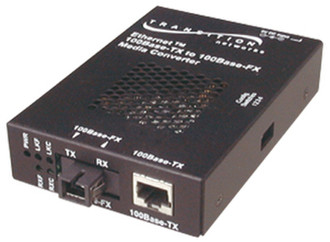
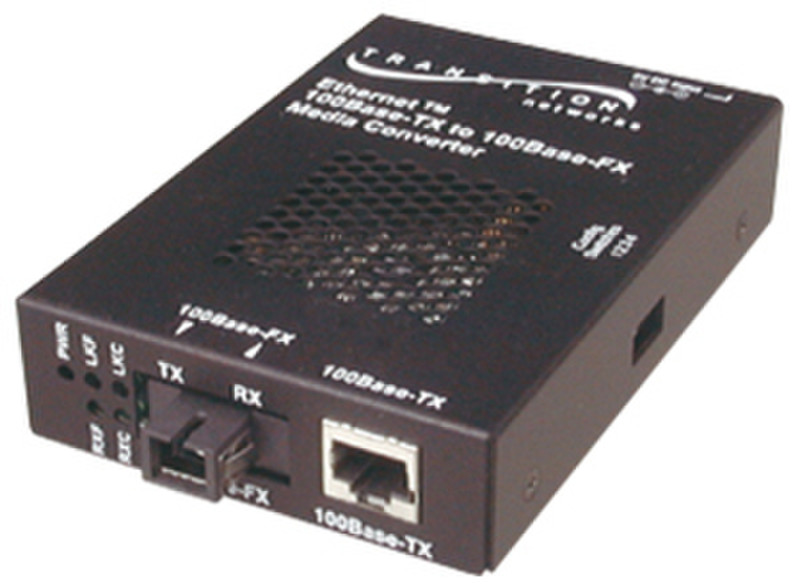
E-100BTX-FX-05(105), 1 x 100BASE-TX (RJ-45), 1 x 100BASE-FX 1550nm TX, 80km, Black
- Operates under heavy traffic loads without excess heat, so there is no need for a failure-prone internal fan.
- Round trip delay of only 40 bit times—far below the Class II rating of 92 bit times.
- Auto-Negotiation (802.3u) - Allows devices to perform automatic configuration to achieve the best possible mode of operation over a link.
- AutoCross™ - Automatically detects and configures the twisted pair port on the converter to the correct MDI or MDI-X configuration.
- Link Pass Through - Link Pass Through is a troubleshooting feature that allows the media converter to monitor both the fiber and copper RX ports for loss of signal.
- Far End Fault (FEF) - A troubleshooting feature that is generally used in conjunction with Link Pass Through to notify both end devices of a loss of link.
- Automatic Link Restoration - Transition Networks's converters will automatically re-establish link in all network conditions.
- Pause (IEEE 802.3xy) - Pause signaling is an IEEE feature that temporarily suspends data transmission between two devices in the event that one of the devices becomes overwhelmed.
- The converters will also automatically re-establish link when connected to two 10/100 auto-negotiating switches if link is lost. With other manufacturers' converters the user must intervene to re-establish link.